Blue and Gold Lock on Ddns Asus Router
The Asus ROG Rapture GT-AXE11000 Wi-Fi 6E Gaming Router, originally announced in September 2020, didn't materialize until early 2021. And it still made it to be the very first Wi-Fi 6E broadcaster in the world.
Months later, there are still just a few 6GHz clients, namely, the Samsung S21 Ultra and the Intel AX210 chip. I tested the new router with both, and it proved to be an excellent performer with lots to offer.
Here's the bottom line: Considering the expensive cost of $550 and the general lack of 6GHz clients, there's no rush to get the GT-AXE11000 now. It'll only get better and more affordable over time. But if you can't wait, chances are you'll love it as long as you can look past the ugly design.
Dong's note: I first published this post as a preview on January 8, 2021, and upgraded it to a full (preliminary) review on January 27 without 6GHz performance, which I added in this final update on April 30.

Table of Contents
Asus's ROG Rapture GT-AXE11000: A new type of (AiMesh) tri-band entirely
As the name suggests, the Rapture GT-AXE11000 is the Wi-Fi 6E version of the GT-AX11000 that came out in early 2019.
(No, you can not upgrade the GT-AX11000 to Wi-Fi 6E via firmware. This is the case with all existing Wi-Fi 6 hardware.)
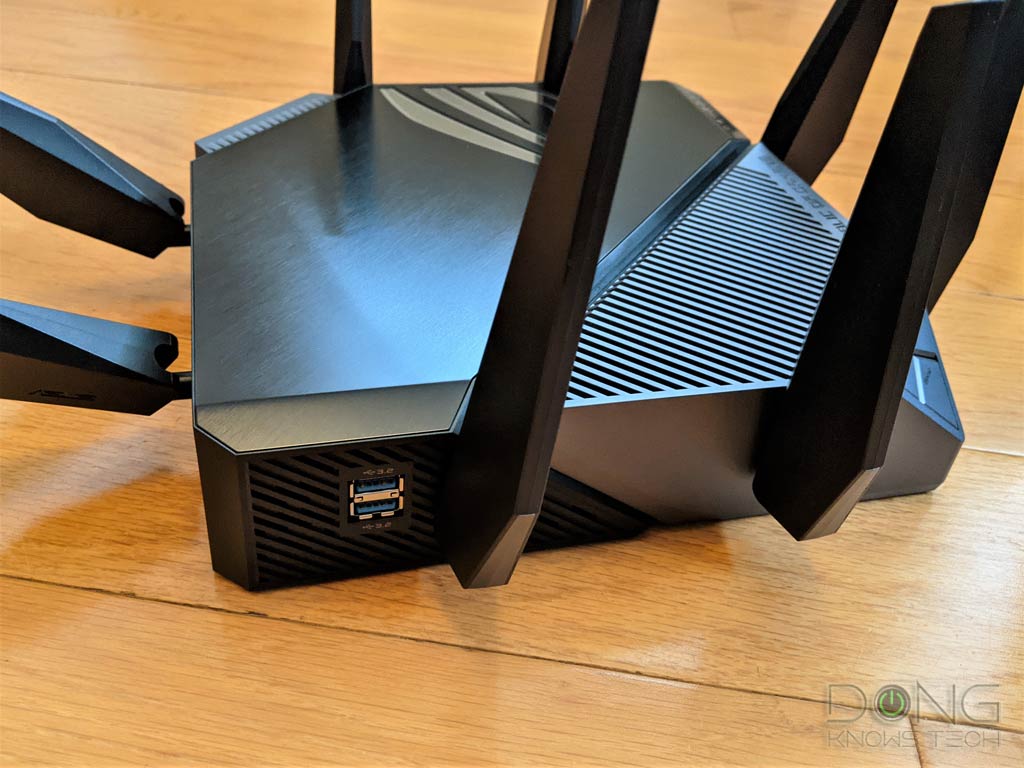
The GT-AXE1100 is a massive squarish box with eight fat antennas — now non-removable — sticking out from the sides. On top, there's that huge programmable eye-catching Asus Aura RGB game light.
Frankly, despite the cool color-changing LED, the design is quite ugly — somebody has run out of design creativity. But if you think it's "totally rad," I'd agree, too — mostly because I'm open-minded. That said, let's dive right into the Wi-Fi 6E notion.
Asus GT-AXE11000 vs. GT-AX11000: A tale of two tri-band routers
That said, without fully compatible 6GHz clients, the GT-AXE11000 is, for now, for the most part, a dual-band (2.4GHz + 5GHz) router. But it resembles the tri-band GT-AX1100 in terms of features (and physical size). There are a lot of similarities between the two.
In fact, swap out one of the latter's two 5GHz bands for a 6GHz , and you get yourself the former. For the most part, everything else of the two remains the same.
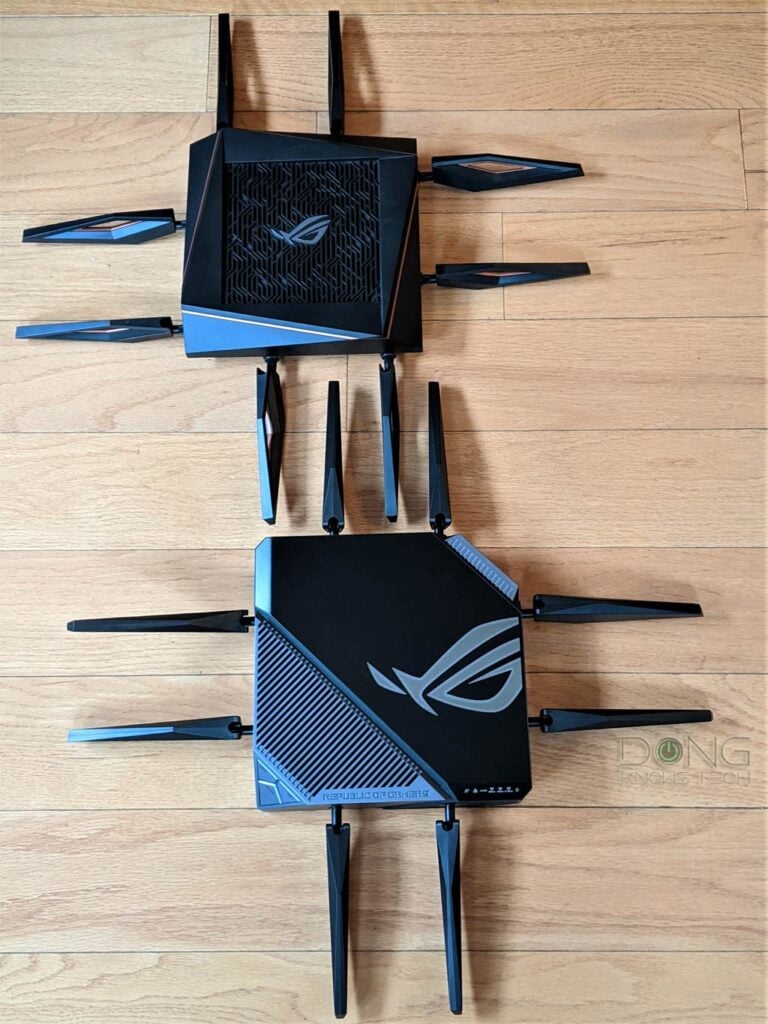
And here's the interesting part: While the GT-AX11000 is a high-end Wi-Fi 6 router — it has an additional 5GHz band — the GT-AXE11000's tri-band configuration is the norm of a Wi-Fi 6E router.
For backward compatibility, tri-band is now a necessity. We need all of them to make sure a router will work with all existing clients. Though each band's specs might vary, it's safe to say all Wi-Fi 6E routers will have at least three bands (2.4GHz + 5GHz+ 6GHz ).
Both routers share the same total bandwidth, but they use them differently. The AX11000 doubles down on 5GHz clients and has no support for 6GHz ones, whereas the AXE11000 has one band for each client type.
The 6GHz band aims to deliver seven more 160MHz channels that are not part of the problematic DFS spectrum. The goal is that 6GHz clients can connect at high speeds without ever being disrupted by radar signals.
So, in reality, the GT-AXE11000 is a different router entirely. It's not an upgrade or replacement of the GT-AX1100. If anything, again, it's more similar to other dual-band routers, such as the RT-AX88U or RT-AX86U, in Wi-Fi hardware.
Hardware specifications
Looking at the GT-AXE1100, though, you can't help thinking of the GT-AX1100. So I'll pitch the two against each other in this part. And they indeed share almost the same hardware and differentiate only by the third band.
| Asus ROG Rapture GT-AXE11000 | Asus ROG Rapture GT-AX11000 | |
|---|---|---|
| Model | GT-AXE11000 | GT-AX11000 |
| Wi-Fi Technology | Tri-Band Wi-Fi 6E AX11000 | Tri-Band Wi-Fi 6 AX11000 |
| First Band | 2.4GHz 4×4 Wi-Fi 6 Up to 1148Mbps | 2.4GHz 4×4 Wi-Fi 6 Up to 1148Mbps |
| Second Band | 5GHz 4×4 Wi-Fi 6 Up to 4804Mbps | 5GHz 4×4 Wi-Fi 6 Up to 4804Mbps |
| Third Band | 6GHz 4×4 Wi-Fi 6E Up to 4804Mbps | 5GHz 4×4 Wi-Fi 6 Up to 4804Mbps |
| Backward Compatibility | 802.11a/b/g/n/ac | 802.11a/b/g/n/ac |
| Wi-Fi 6E (6GHz) Support | Yes | No |
| AP Mode | Yes | Yes |
| Mesh-ready | Yes (AiMesh 2.0) | Yes (AiMesh 2.0) |
| 160MHz Channel Support | Yes | Yes |
| Number of 160MHz Channels | 7x on one 6GHz band 2x on one 5GHz band | 2x on two 5GHz bands |
| Gigabit Network Port | 4x LAN, 1x WAN | 4x LAN, 1x WAN |
| Multi-Gig Network Port | 1x 2.5Gbps LAN/WAN | 1x 2.5Gbps LAN/WAN |
| LAN Link Aggregation | Yes (LAN ports 1 and 2) | Yes (LAN ports 1 and 2) |
| WAN Link Aggregation | Yes (WAN + LAN4) | Yes (WAN + LAN4) |
| Dual-WAN | Yes (WAN + USB or LAN4 or 2.5Gbps) | Yes (WAN + USB or LAN4 or 2.5Gbps) |
| USB | 2x USB 3.0 | 2x USB 3.0 |
| Mobile App | Asus Router | Asus Router |
| Processing Power | 1.8 GHz quad-core CPU, 256MB Flash, 1GB RAM | 1.8 GHz quad-core CPU, 256MB Flash, 1GB RAM |
| Dimensions (no antennas) | 10.4 x 10.4 x 2.9 in (26.4 x 26.4x 7.4 cm) | 9.5 x 9.5 x 2.4 in (24.1 x 24.1 x 6.1 cm) |
| Weight | 3.94 lbs (1.79 kg) | 3.8 lbs (1.73 kg) |
Asus GT-AXE11000: A feature-richer gaming router
At the outset, the GT-AXE11000 is a gaming router, just like its older cousin. Asus categorizes the router's game acceleration into three levels, including ports, packets, and servers.

Specifically, like the RT-AX86U's (or RT-AX82U's) case, the new router has a dedicated Gaming Port — its 2.5Gbps port. That's a LAN port that automatically prioritizes any connected wired device.
After that, the GT-AXE11000 includes fancy NAT- and QoS-based Game sections within its web interface to prioritize game-related packets. You can find pre-configured settings for a long list of particular games.
Finally, the GT-AXE11000 is the first that comes with a 90-day free trial of the Outfox gaming network that manages the server-side of gaming. This feature replaces the WTFast gamer VPN support, which is part of the GT-AX11000 and the RT-AX92U but is no longer available in the GT-AXE11000.
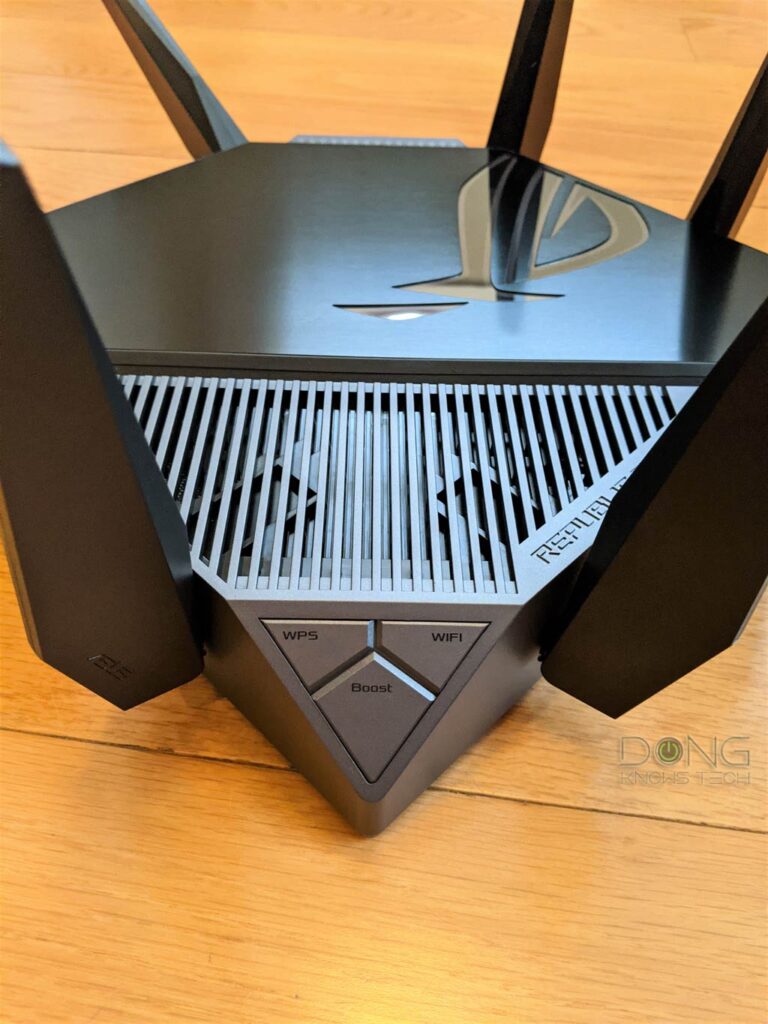
On top of that, you can also prioritize the game gear, including consoles, mobile devices, or PCs. And the router now has a programable Boost hardware button. A press on it will toggle one of the following:
- Enabling the Game Boost feature.
- Auto-selecting the best Wi-Fi channels, including DFS ones.
- Turning the router's LEDs on or off
- Toggling Aura RGB lighting
So, it's safe to say, if you're looking for any trick that can squeeze the best out of your Internet connection for gaming or want some fancy vanity to heighten the mood, the GT-AXE11000 has it all. In other words, get this router, and you have no more excuses.
A bit of disclosure: I'm not a big gamer, definitely not a competitive one, at least not anymore. (I considered myself one a while back, but I then fell in love and now have different priorities — you can't have everything!) But I did try most of these features out briefly, and they sure seemed to help, or maybe what I experienced was a placebo effect.
Like the case of all gaming routers, though, your mileage will vary. These features are special QoS or NAT settings at their core and can only do so much on a particular broadband connection.

Excellent port flexibility
Like the GT-AX11000, the GT-AXE11000 comes with two USB 3.0 ports and six network ports, including four Gigabit LANs, one Gigabit WAN, and one 2.5Gbps LAN/WAN port. And you can use these ports quite flexibly.
Specifically:
- Multi-Gig port: The 2.5Gbps can work as a WAN or a LAN port. As the latter, it also works as the Game Port mentioned above. Note that by default, it can work as the WAN right away. But if you choose to use the default WAN port, it will work as a LAN after the setup process.
- WAN port: You can pick the WAN port (default), the 2.5Gbps port, or a USB port as the primary WAN port. When not used as its default role, the WAN port works as a LAN.
- Dual-WAN: You can use the WAN port plus LAN1 (or the 2.5Gbps port or a USB port) in a Dual-WAN setup if you have two broadband connections. The USB or only supports certain cellular dongles. It won't work with a USB-to-Ethernet adapter.
- LAN Link Aggregation: You can bond the LAN1 and LAN2 ports into a 2Gbps LAN connection.
- WAN Link Aggregation: You can combine the WAN and LAN4 ports into a 2Gbps WAN connection when working with a supported modem.
Note, though, that you cannot expect to use all of the above at once. The GT-AXE1100 router doesn't have enough ports for everything to begin with. So, you'll likely wish the router had more ports.
I definitely wish it had some 10Gbps ports like the case of the RT-AX89X — there sure is enough physical space on the router for them.

All core features and setting of an Asus router
On top of that, the GT-AXE11000 also includes all core features and settings found in most Asus routers. Following are what you can expect:
- Universal setting restoration: In my testing, I could restore the backup files from many existing Asus routers, both dual-band and tri-band, to the GT-AXE11000. This is an excellent bonus in case you want to do an upgrade and have a ton of settings — especially port-forwarding and IP reservation entries — on your current Asus router.
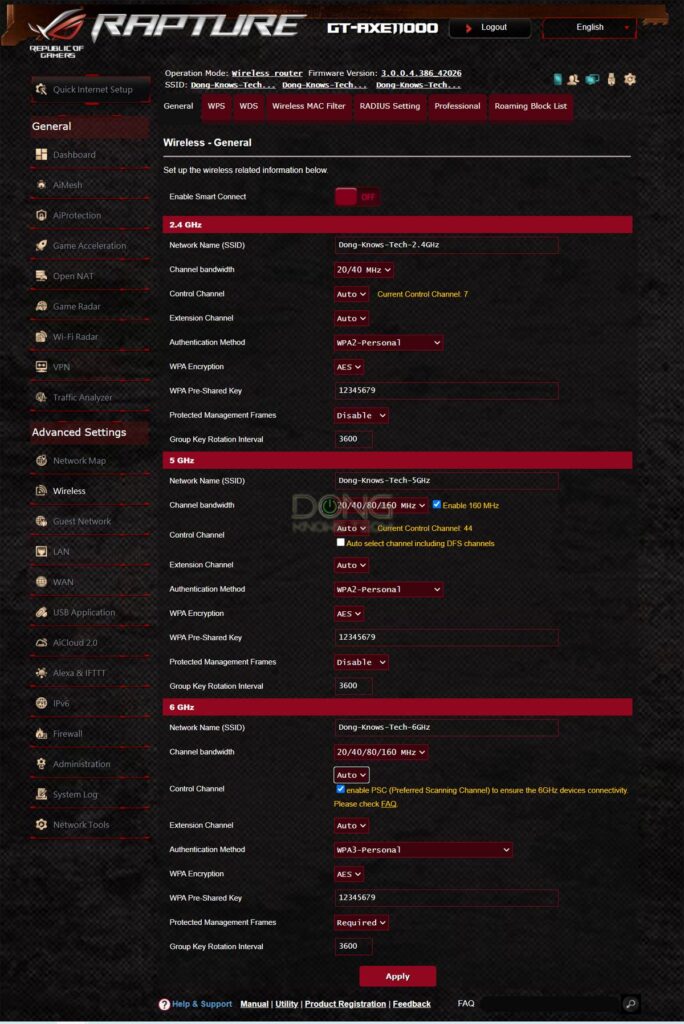
- A robust full web user interface: Asus's web user interface is one of my favorites. It's intuitive and allows for in-depth customization. But the interface can be overwhelming for novice users.
- Helpful Asus mobile app: Alternative to the web UI, users can use the Asus mobile app to manage and set up their router. It's a well-designed app with decent access to the router. You can also turn on the Dynamic DNS-based remote access without having a login account with Asus.
- AiProtection-Pro: This feature includes a free-for-life real-time online protection powered by Trend Micro and a Parental Control engine for parents wanting to keep tabs on their children's online life.
- Adaptive QoS: A quality of service engine that allows you to prioritize Internet traffic to support different applications or services. Adaptive QoS requires minimum work from the user and is effective. It also includes Bandwidth Monitor if you want to know who uses the most Internet at all and Web History that shows the websites a client has visited.
- Traffic Analyzer: A set of tools and statistics if you want to find out what's been going on in the network in a set amount of time or real-time.
- USB-related features galore: When hosting a storage device, the router has all the features you can imagine — from data sharing (locally and over the Internet) to backup (including the support for Time Machine) to a personal cloud. You can also use the router's USB ports to host printers or select USB cellular modems.
- Frequent firmware releases: Asus regularly pushes out new firmware updates to improve its routers. For the most part, this is a good thing. However, once in a while, new firmware can cause issues. In this case, you should downgrade the router to the previous stable version and wait for the next release. (Asus routers don't auto-update firmware by themselves.)
In short, as a standalone router, you likely can expect the GT-AXE11000 to deliver everything collectively found in previous Asus routers and more. Also, if you've used an Asus router before, you'll feel right at home with this one.
ROG GT-AXE11000: Detail photos
The GT-AXE11000 is a massive Wi-Fi machine. It's slightly larger than the GT-AX11000. Both are equally ugly or cool, depending on who you are.
I do like the fact its antennas are now non-detachable. It was a pain to assemble them in the case of the GT-AX11000.




Asus GT-AXE11000: The uncharted territory of AiMesh
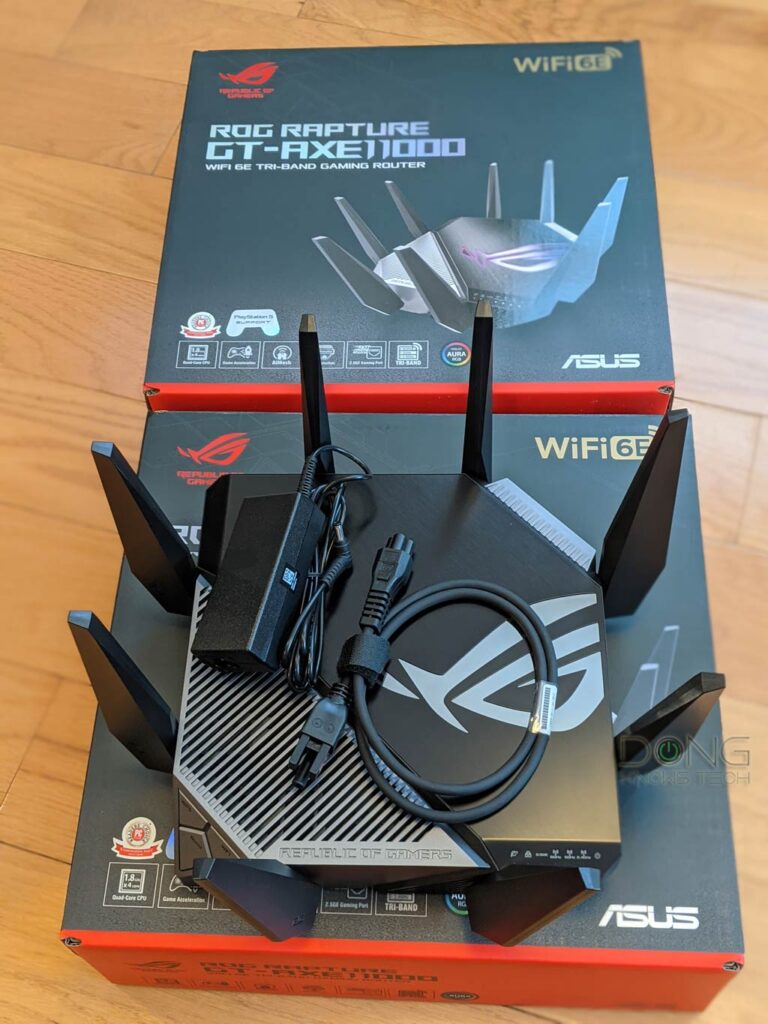
As mentioned above, I got two GT-AXE11000 units and, among other things, was able to test them in an AiMesh setup.
First and foremost, the GT-AXE1100 supports AiMesh 2.0 fully right out of the box. This means, among other things, it will deliver system-wide Guest networks (one or each band) when supported nodes (those using firmware version 386 or later) are used.
Another good news is you can use the router's 2.5Gbps as the backhaul. So if you have two units (and no more) and have gotten your home wired, it's a guarantee that you will have a 2.5Gbps backhaul link between them.

Now here comes the bad news, likely due to the firmware's beta status and the early state of Wi-Fi 6E. In my experience, the mesh didn't work out as one might have hope.
- Slow Multi-Gig: The 2.5Gbps port on the node unit was very slow in my testing, with sustained speed capping at some 60MB/s (480Mbps) at best. This was quite strange since it functioned fine when the same router worked in the main router role. For this reason, it's not a good idea to use this port for wired backhaul, at least for now. The 1Gbps WAN port was fine for this role, however.
- The backhaul conundrum: In a wireless backhaul mode, the 6GHz band works as the dedicated one. However, if you add another pre-Wi-Fi 6E router, such as the RT-AX92U or GT-AX11000, to the mesh, expect the following:
- You can't do it wirelessly — the adding process likely fails. It never worked in my trial.
- Now, if you use a network cable to connect this router to the main GT-AXE11000 (wired backhaul), the setup will go through. But if you remove this cable, the 2.4GHz band will work as the backhaul. Not a good setup.
If you choose to add the RT-AX92U first and then the 2nd GT-AXE11000 after, both the 5GHz and 6GHz bands will work as wireless backhaul, but neither is dedicated — they are both available to clients.
So overall, if you choose to use the GT-AXE11000 in an AiMesh setup of mixed hardware, make sure you use wired backhauls. If you go full wireless, you need to use just the GT-AXE11000 units. And even then, you might run into issues, in addition to the crazy cost.
Of course, as AiMesh goes, things will change via a firmware update.
AiMesh: Asus's ongoing journey to bettering Wi-Fi coverage
Asus GT-AXE11000: Fast performance
By the time of this update, I've used the GT-AXE11000 for a couple of months, sometimes for weeks on end, and it proved to be an excellent performer with reliable Wi-Fi signals.
The router can work as a member of an AiMesh system. Again, in this case, you should only use it in a wired setup.
By the way, the GT-AXE11000 is a 4×4 broadcaster, but there are only 2×2 clients on the market. But thanks to the support for the 160MHz channel width and the 2.5Gbps LAN port, it easily delivered Gig+ Wi-Fi speeds in my testing method.
The 6GHz band: Fast performance, short-range
I tested the router with two Samsung S21 Ultras — the only official Wi-Fi 6E clients for now — and a couple of laptops running the Intel AX210 chips with the latest "cheat" driver.
It's worth noting that my 2×2 test client could connect to this band consistently at 2.4Gbps on negotiated speed without me having to tweak anything on the router's end. That never happens with the 5GHz band.

In terms of throughputs, at a close range of fewer than 10 feet (3m), the router had a sustained speed of almost 1500Mbps. Father out at 40 feet (12m) away, it still averaged almost 1400mbps.
The GT-AXE11000's 6GHz band clearly had a shorter range than the 5GHz — that's just the nature of Wi-Fi 6E. Within the line of sight, its signals began to wane at about 50 feet away. With a wall in between, I no longer had full bars just 40 feet away. The router's 5GHz band was generally at least 30% better in terms of coverage.
That said, if you have an open room, the 6GHz is still an excellent additional band to have.
An excellent broadcaster for mainstream clients
Don't have any 6GHz clients yet? Well, the GT-AXE11000 also proved to be an excellent router when working with 5GHz and 2.4GHz devices too.

Indeed, it proved to be one of the fastest routers when working with 2×2 Wi-Fi 6 clients, with a sustained speed of 1500Mbps at less than 10 feet (3 m) away. When I increased the distance to 40 feet, it now still registered some 1200Mbps.
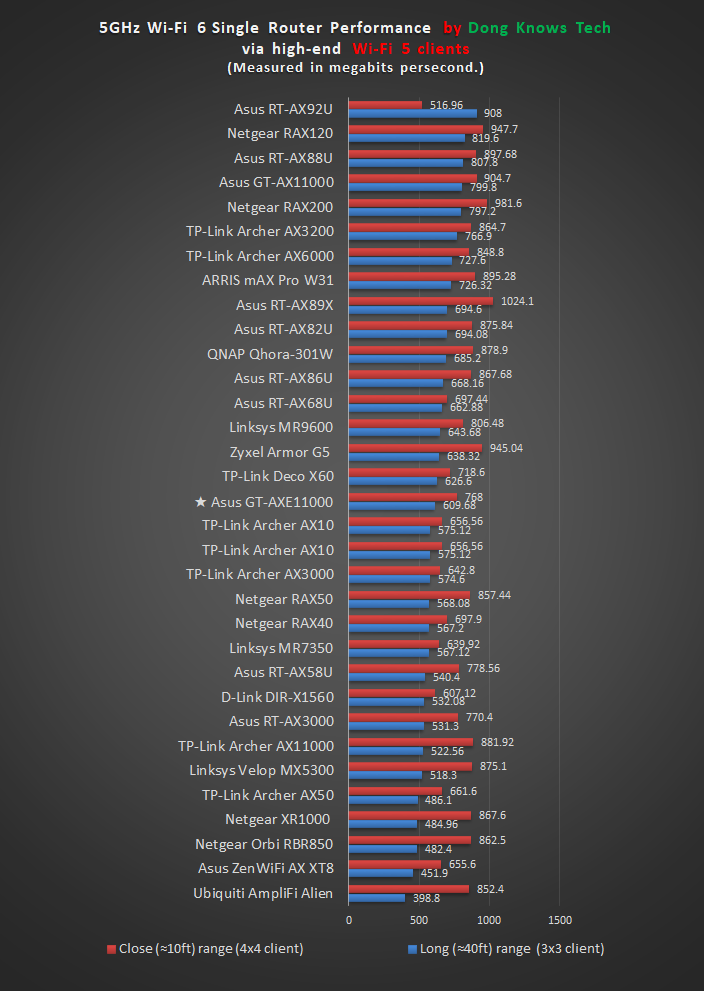
The new router also did well with Wi-Fi 5 clients, averaging between 600Mbps and 770Mbps within 40 feet range.
And like the case of the GT-AX11000, the GT-AXE11000 was one of the fastest routers I've tested on the 2.4GHz band. My 2×2 Wi-Fi 6 client averaged faster than 400Mbps at the close range and some 210Mbps at 40 feet away.

The GT-AXE11000 had about the same range as the GT-AX11000 in my testing, which is excellent. Conservatively, if your home is of some 2000 ft2 (186 m2), chances are a single unit will take care of it. Keep in mind that your mileage will vary since the Wi-Fi range depends on many factors.
Another fast mini NAS server
The GT-AXE11000 will work well as a mini NAS server, too, when hosting a storage device. I tested it with the new WD My Passport SSD, and the performance was quite excellent.

Especially, via a 2.5Gbps wired connection, it registered the sustained copy speed of some 140MB/s for writing and almost 150MB/s for reading. Via a Gigabit connection, it now averaged 107MB/s and 112MB/s, respectively.

Pros
Tri-band with Wi-Fi 6E support
Excellent 5GHz and 2.4GHz performance
Excellent set of game-related, online protection and monitoring features, full AiMesh 2.0 support
2.5Gbps LAN/WAN port, Dual-WAN, and LAN/WAN Link Aggregations
Cons
Wi-Fi 6E is not fully available
Only one 2.5Gbps port, no 10Gbps port
Bulky design, not wall-mountable, buggy firmware (at launch)
Conclusion
As the most expensive Asus router to date, the Asus ROG Rapture GT-AXE11000 Wi-Fi 6E Gaming router is not ready for prime time. For that, you'll have to wait till Wi-Fi 6E clients are more readily available.
For now, you'll need to do some work to get the Intel AX210 adapter to work or pay a lot for the Samsung S21 Ultra.
That said, get it if you're willing to spend cash on the idea of staying ahead of the curve. And you probably will love it despite the fact, for the most part, it'll give you a similar experience to the much more affordable RT-AX86U.
Source: https://dongknows.com/asus-rog-rapture-gt-axe11000-wi-fi-6e-router-review/
0 Response to "Blue and Gold Lock on Ddns Asus Router"
Post a Comment